
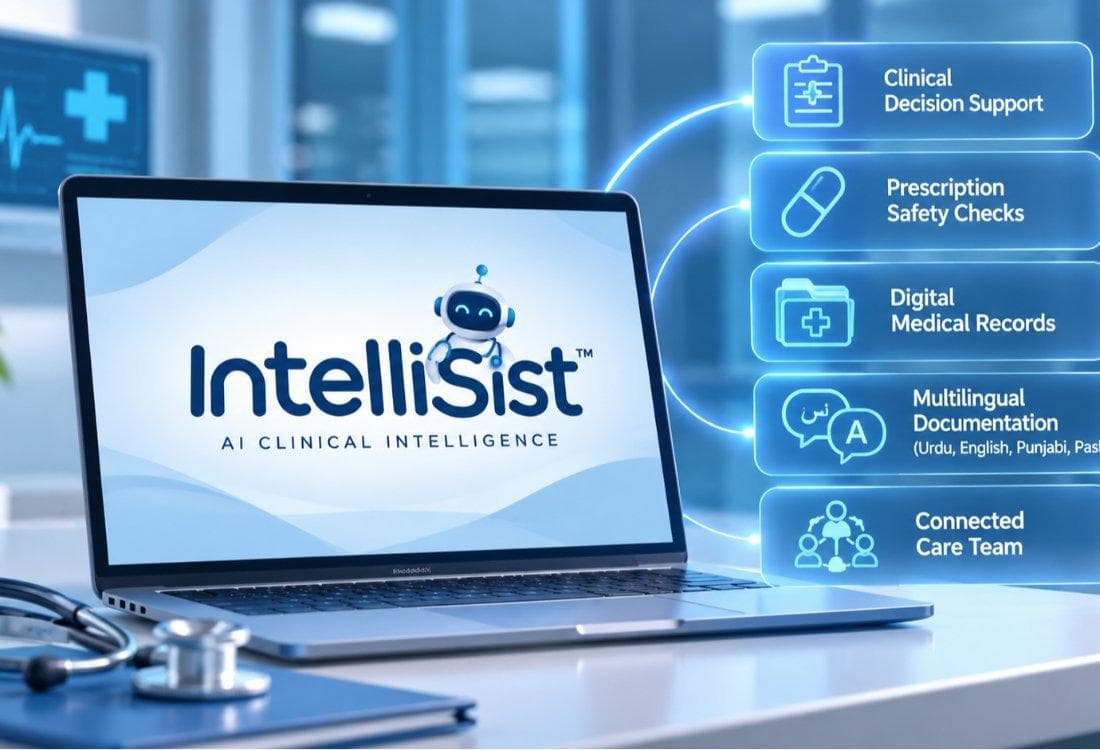
Artificial intelligence is gradually becoming part of healthcare delivery around the world, including Pakistan. From digital patient records to AI-assisted clinical documentation, technology is creating new ways for doctors to access information and manage medical consultations.
However, one of the most important questions surrounding AI in healthcare in Pakistan is how these systems can support doctors without replacing professional medical judgment.
Reliance Hospital in Rawalpindi has announced IntelliSist™, an AI clinical intelligence technology developed by D-Right Technologies.
IntelliSist is designed to assist healthcare professionals with clinical documentation, medical history, evidence-based decision support, medication safety, and coordination between hospital departments.
Its role is to support the physician throughout the clinical workflow.
What Is Artificial Intelligence in Healthcare?
Artificial intelligence in healthcare refers to software systems that can process information, identify patterns, organize medical records, and provide relevant insights for healthcare professionals.
Depending on their design, these systems can support tasks such as:
Organizing consultation notes and patient information.
Reviewing documented medical history.
Highlighting possible medication-related risks.
Providing guideline-aware clinical suggestions.
Supporting communication between healthcare departments.
AI systems do not automatically understand every aspect of a patient's condition, and their suggestions may sometimes be inaccurate or incomplete.
For this reason, human clinical review remains essential.
What Is an AI Clinical Decision Support System?
A clinical decision support system, commonly called a CDSS, is technology that provides information to assist healthcare professionals during medical assessments.
For example, when a doctor evaluates a patient with fever, the physician considers symptoms, examination findings, medications, medical history, and investigation results.
A clinical decision support system can help organize the available information and identify relevant considerations.
IntelliSist includes guideline-aware support for clinical history, examinations, investigations, diagnosis, and treatment planning.
The system is designed to provide suggestions, while the consultant retains responsibility for deciding what is clinically appropriate.
How IntelliSist Supports Medical Assessments
Reviewing Patient History
A patient's previous medical conditions may influence decisions made during a new consultation.
Someone visiting a doctor for an infection may also be receiving treatment for heart disease, diabetes, or another condition.
The doctor must consider this background before recommending treatment.
IntelliSist can assist by presenting relevant information from available medical records.
Organizing Clinical Documentation
Accurate clinical notes are important for follow-up care, communication, and treatment review.
IntelliSist includes voice and text-based documentation capabilities that organize clinical information into structured notes.
This can help doctors maintain clearer records of patient consultations.
Supporting Evidence-Based Decisions
Clinical guidelines provide recommendations based on available medical evidence.
IntelliSist is designed to offer guideline-aware assistance during clinical assessments and treatment planning.
However, medical guidelines cannot account for every individual circumstance.
The physician must determine whether any suggestion is suitable for the particular patient.
How AI Can Support Prescription Safety in Pakistan
Medication safety is an important part of healthcare.
Patients may receive several prescriptions over time, sometimes from different specialists. This can increase the importance of carefully reviewing their medication lists.
IntelliSist includes several features intended to support safer prescribing.
Drug Interaction Alerts
Some medicines can interact with one another, potentially changing their effects or increasing the risk of adverse reactions.
IntelliSist can check for potential interactions based on available medication information.
For example, certain antibiotics may interact with warfarin, a medicine used to reduce blood clotting.
When the system identifies a possible interaction, it can alert the doctor to review the medication combination and any necessary monitoring.
Allergy Checks
A patient's known medication allergies should be considered before prescribing treatment.
IntelliSist is designed to use documented allergy information when reviewing medication-related risks.
This does not replace direct confirmation of allergies with the patient.
Duplicate Medication Checks
Patients may sometimes receive medicines with similar active ingredients or overlapping purposes.
AI-assisted prescription review can help flag possible duplication for a physician's attention.
Dosing Considerations
Medication doses may depend on factors such as age, clinical condition, kidney function, and other medical information.
IntelliSist includes dosing checks intended to support clinical review.
The physician must still confirm whether a particular dose is appropriate.
Can AI Prevent Medication Errors?
AI can provide additional checks that may help identify some medication-related concerns before a prescription is finalized.
However, no clinical decision support system can guarantee the prevention of all prescribing errors or adverse reactions.
The accuracy of alerts depends on factors such as patient information, software design, clinical context, and the quality of available evidence.
IntelliSist uses a graded medication-risk approach to help communicate the seriousness of potential concerns.
Doctors remain responsible for evaluating alerts and making final prescribing decisions.
Electronic Medical Records and Connected Hospital Care
Electronic medical records, or EMRs, store documented patient information in digital form.
They may include consultation notes, medical history, diagnoses, medicines, investigations, and treatment plans.
When different departments use connected clinical information, healthcare professionals may be able to coordinate patient care more effectively.
IntelliSist is designed to support linked clinical workflows across outpatient, emergency, and inpatient services.
Its care-team coordination features connect the activities of consultants, medical officers, nursing staff, pharmacy teams, and laboratories.
For example, a physician's instruction for an investigation can become part of a coordinated clinical workflow.
This approach is intended to make relevant information easier for the appropriate healthcare professionals to review.
Multilingual AI Medical Documentation
Pakistan's healthcare system serves patients who speak different languages.
Patients may describe symptoms in Urdu, Punjabi, Pashto, or English, depending on their preferences and background.
IntelliSist includes multilingual clinical documentation capabilities to support these languages.
By processing spoken clinical information, the technology can help structure consultation notes for professional review.
This has potential value in busy healthcare settings where clinical staff must manage both patient communication and documentation.
Patient Privacy and Responsible AI Use
As hospitals adopt digital records and AI systems, patient privacy remains a critical consideration.
Medical information is sensitive and should be handled through appropriate access controls, documentation procedures, and security measures.
Patients should be informed about how their medical information is used.
Where consultation audio is recorded or processed, hospitals should follow applicable consent, privacy, and information-handling requirements.
AI-generated clinical suggestions should also be reviewed by qualified healthcare professionals before they influence patient care.
IntelliSist at Reliance Hospital Rawalpindi
Reliance Hospital has announced IntelliSist as part of its approach to technology-supported healthcare.
The system is developed by D-Right Technologies and designed to work alongside medical professionals.
Its clinical intelligence capabilities include structured documentation, medical history review, evidence-based support, prescription safety checks, and care-team coordination.
Through IntelliSist, Reliance Hospital is taking steps toward integrating AI-assisted workflows into its clinical environment.
Frequently Asked Questions
How is AI being used in healthcare in Pakistan?
AI is being explored for clinical documentation, digital medical records, diagnostic assistance, medication safety, administrative workflows, and clinical decision support.
What is IntelliSist?
IntelliSist is an AI-powered clinical intelligence technology developed by D-Right Technologies to support medical documentation, clinical decision-making, medication checks, and coordination of care.
Can AI check drug interactions?
Appropriately designed AI-assisted clinical systems can identify potential medication interactions using available prescription and patient information. Doctors must review these alerts before making treatment decisions.
Does AI make medical decisions independently?
IntelliSist is designed as a physician-support system. Qualified doctors remain responsible for clinical assessments and treatment decisions.
Is IntelliSist available at Reliance Hospital?
Reliance Hospital in Rawalpindi has announced IntelliSist as part of its clinical technology initiative. Patients can contact the hospital to confirm the features currently in use.
The Future of AI-Assisted Healthcare in Pakistan
Artificial intelligence has the potential to support healthcare professionals through better documentation, accessible clinical information, and additional safety checks.
Its value ultimately depends on responsible implementation, accurate data, professional oversight, and patient trust.
IntelliSist represents one approach to incorporating these capabilities into hospital care.
For information about Reliance Hospital and its medical services in Rawalpindi and Islamabad, visit www.reliancehospital.org.