
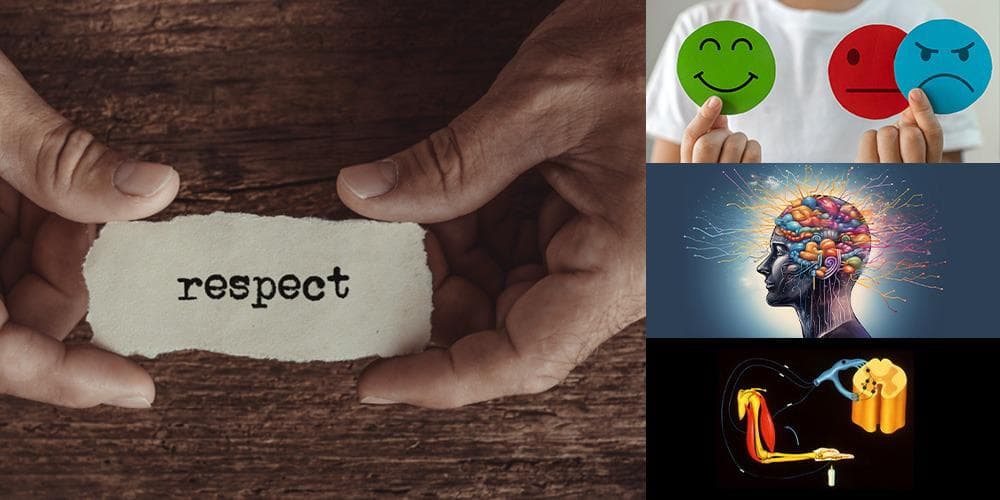
Respect is often discussed as an emotion or feeling, something that arises naturally when we encounter someone or something that aligns with our values, beliefs, or societal norms. However, an alternative perspective views respect not merely as a spontaneous emotional response but as a cognitive decision or a practicing reflex that is shaped by our physiological responses, and social constructs. This article delves into this multifaceted concept, examining it through the lenses of physiology, and sociology.
Physiological Perspective: Respect as a Cognitive Process
From a physiological standpoint,
emotions are closely tied to our brain's limbic system, which governs our
emotional responses. While respect may seem to be an emotion, it differs in
that it often requires conscious thought, reflection, and judgment. The
prefrontal cortex, responsible for decision-making and reasoning, plays a
crucial role in this process. Unlike emotions like fear or joy, which can be
immediate and visceral, respect often involves an assessment of context, norms,
and values, indicating that it is more aligned with higher-order cognitive
functions.
Respect as a cognitive process
also involves the autonomic nervous system, particularly when it comes to
practicing respect reflexively. For instance, the decision to show respect
through certain behaviors—such as standing up when someone enters the room—can
become a conditioned response, a practiced reflex that, over time, becomes
nearly automatic. This illustrates how respect can evolve from a cognitive
decision into a reflexive behavior through repetition and social learning.
Sociological Perspective: Respect as a Social Construct
Sociologically, respect is a
construct that is deeply embedded in the fabric of society. It is not just a
feeling but a social expectation and a norm that guides interactions within a
community. Respect is taught, learned, and reinforced through socialization
processes. For instance, in many cultures, respect for elders or authority
figures is a fundamental aspect of social interaction. This is not merely
because people feel respect towards these individuals but because societal
norms dictate that such respect is due.
Theory of social capital can also
be applied here, where respect functions as a form of symbolic capital within a
society. People are often respected based on their position, achievements, or
social roles, and this respect is a reflection of the value society places on
these attributes. Thus, respect is more of a social currency than an emotion,
traded and accrued based on one’s actions, status, and adherence to societal
norms.
Interplay of Sociological & Physiological Perspectives
Another important aspect of
sociological perspective is respecting someone as part of learnt behavior. When younger individuals observe their
parents or elders consistently showing respect for someone, they are likely to
imitate this behavior, even if they do not fully understand the reasons behind
it. This imitation can become a practiced reflex over time, ingrained through
repeated exposure and reinforcement. For example, if parents consistently greet
a family friend with kindness, listen attentively when that person speaks, and
speak about them with positive regard, children will likely pick up on these
cues. They learn that this person is someone to be respected because their
parents, who are their primary role models, treat them with respect.
As children grow and continue to
observe respectful behavior, they internalize these actions as part of their
own social norms. This internalization means that they begin to respect the
person not merely because they are copying their parents but because they have
adopted this behavior as a natural part of their social conduct. This process
can transform the act of respecting someone into a reflexive behavior—a
response that happens automatically, without the need for conscious thought.
For instance, a child who has seen their parents always offer a seat to an
elderly person may automatically do the same when they grow older, even in the
absence of their parents.
The consistency of the parents’
or elders’ behavior plays a significant role in reinforcing this learned
respect. When the behavior of respecting someone is consistent and positively
reinforced—such as through verbal praise, affection, or approval—children are
more likely to adopt and continue this behavior into adulthood. This
reinforcement helps solidify the behavior as a reflex.
Moreover, the context in which
this respect is shown can further enhance its adoption. For example, if parents
explain why they respect certain individuals, emphasizing values such as
kindness, wisdom, or integrity, children are more likely to understand the
deeper reasons behind the behavior, which further cements it as a cognitive
decision rather than a mere reflex.
Summary Points
While some may argue that respect
must originate from genuine emotion to be authentic, the cognitive perspective
challenges this notion by demonstrating that respect can be a deliberate,
learned behavior. Respect, when viewed as a cognitive decision or practicing
reflex, has the advantage of being consistent and reliable, not subject to the
fluctuations of emotion. It becomes a tool for navigating social and
organizational environments effectively.
In conclusion, respect is much
more than an emotion or feeling. It is a cognitive decision influenced by our
physiology, a social construct that guides behavior, and a practicing reflex
that can be cultivated in domestic, social or organizational settings.
Understanding respect from these perspectives allows us to appreciate its
complexity and its essential role in fostering harmonious relationships and
effective organizations.